Do you remember the first coffee you brewed professionally?
It must have been at Filtry Cafe around 2010. I don’t remember the exact year, but I know for sure it was an Ethiopian Guji brewed in a Chemex.
What a memory! Warsaw’s Filtry – a unique place, Poland’s first specialty coffee shop – whose founder, Konrad Konstantynowicz, trained a whole generation of baristas. How did you end up there?
I applied for the job! I was about 17 or 18 years old and had no experience with coffee. Back then, I mostly just wanted to ride my bike and go to punk concerts. I was just looking for a job. And after talking with Konrad and Magda – who were the owners of Filtry at the time – I got the job. They decided I was a good fit. Because I’m such an “alternative” person (laughs) that I’d be able to handle “alternative” coffee, too.
I understand that was your barista school?
Of course. Filtry trained a whole host of Polish baristas, many of whom later went out into the world, worked at various iconic cafes or roasteries around the globe, or opened their own places in Poland. Konrad trained many such professionals. Filtry was the seed of the specialty coffee movement in Poland.
What was the coffee-brewing training like?
Well, definitely differently than it is now. The training took place during shifts; I didn’t have immediate access to an espresso machine or coffee. I started at the entry-level stations—washing dishes, juicing, slowly working my way through the menu, and getting familiar with everything that goes on in a café. Getting to know people, observing how the already-trained baristas worked. Then there were pre-opening and post-closing training sessions, and that’s how I gradually got up to speed. After that, I only made takeout coffees, because that’s where I could practice latte art. You’d cover it with a lid, so no one could see if it didn’t turn out right. About half a year later, I was already able to work independently and manage a shift. And let’s remember that we’re talking about a place that was only 25, maybe 30 square meters. I think that nowadays, training like that can last a week before you’re behind the machine—in some places, maybe even faster. Today, when I train someone, it takes about three days. Things have sped up considerably. Different times, different realities…
Are we learning faster?
Definitely.

Yesterday, a young person asked me: Hey, what does this “third wave of coffee” mean?
The third wave is about knowing where the coffee comes from. It’s about having a complete understanding of the bean – from the plantation to the cup. It’s about developing alternative, manual brewing methods and having control over the entire process. It’s about greater awareness, learning, and so on.
And what about the first and second waves? Let’s recap…
The first wave was the mass availability of coffee, which emerged in the early 20th century, followed by instant coffee. The second wave developed café culture in the ’60s and ’70s, along with milk-based drinks and syrups (this is where players like Starbucks entered the scene); at that time, the focus was mainly on dark-roasted Arabica. Then came the third wave. Around the year 2000, people began paying attention to the origin of the beans, the differences between varieties and regions of origin, as well as flavor and roast level. And many alternative brewing methods emerged, such as drip, AeroPress, and Chemex (which, incidentally, was designed as early as 1939 but had been somewhat forgotten over the years).
What fascinated you so much about this coffee?
At first, I liked the variety of my tasks at the café. I wasn’t bored for a single moment. I learned a lot, and I got to meet new people all the time! And I also started to take an interest in things related to flavor. I was fascinated that such a simple drink as coffee could have so many different facets. It really opened my mind; I just became fascinated by it. Discovering that there’s such a range, such a palette of different flavors. And it went further – into food, into other drinks. I discovered that I simply enjoy cooking, eating, and drinking. Today, my whole life is devoted to these areas. I never in my life would have thought this could happen, because I drank orange juice at my job interview. I didn’t want to drink coffee because I’d never had it before (laughs). I mean, I’d had instant coffee maybe three times here and there, but a properly brewed cup – never.
Were you drawn to the fact that Filtry had such an alternative vibe?
Yeah, it was pretty punk in general, and I liked that. That no one judged me too harshly as some young weirdo… Filtry had a cool, tight-knit team, good training, and great people at the café.
What happened next?
I stayed at Filtry for quite a while – almost 5 years – and had already started training young baristas. And when I took second place in the Cup Tasters championship, I felt it was time to move on. That’s when Konrad Oleksak reached out and brought me to Kofi Brand. Then I went abroad – I worked at the Swedish roastery Koppi, first as a bar manager and later as an assistant in the roastery alongside Błażej Stępin, who was the head roaster there. After that, I ended up at Lilla Kafferosteriet, where I served as head roaster and managed the café. A three-story house, one of the oldest in Malmö, and such a huge place – eight baristas per shift; we’d go through 10 kilos of coffee in 8 hours just for espresso. It was serious business—I felt like Gordon Ramsay (laughs).

Tell me, how did working conditions in Poland differ from those in Sweden? Was there anything there that was a revelation, a change, or a surprise?
Well, first of all, there was no way to work more than the system allowed. Wages were determined based on skill—in a very clear-cut way. You couldn’t go beyond a certain range in either direction. A barista earned 120 kronor when they started, and an experienced one earned a maximum of 160 kronor. Period. I really liked that everything was so clear and no one tried to cheat anyone. In Poland, there wasn’t that kind of clarity—I’m not talking about Filtry or Kofi Brand here, but about the various odd jobs I did… Attempts to pull a fast one were the order of the day. In Sweden, the workweek was shorter, shifts were shorter, and you didn’t work nonstop. Workplace conditions were simply different. There, I learned that you can have a personal life while working, rather than just working to make a living. That was the big, huge difference.
Why did you come back to Poland?
I missed my homeland! Seriously! I’m Polish, I love Poland! I also started to get tired of the cultural differences. I lived in Copenhagen, Denmark, for a while – it’s just a stone’s throw from Malmö, just a bridge away. I moved there with my girlfriend, but we broke up, and after a few years, there was nothing keeping me there anymore. Of course, I had a few friends. .. But here in Warsaw, I had my friends. To be honest, I didn’t quite fit in with the so-called Swedish mindset. I’m too intense, too bold, and I like to speak my mind. People don’t act that way there. Well, maybe only once you know someone really well – once you’ve been to their house—can you show your true emotions. But on a day-to-day basis – it’s all like a performance behind a curtain… On a daily basis, you exchange two sentences and that’s it. No one wants to talk about anything serious. In Poland, when you meet someone, you can tell them your whole life story, and everyone is curious – they’ll give you advice, find a way to keep the conversation going. Over there, the conversations were mostly about nothing, and if someone wanted to go a little deeper, there was no way to do it. Anyway, I didn’t have many Swedish friends—there were more people from Africa, from Australia; there are quite a few immigrants there. But maybe it’s just that I love Poland? Besides, I went there to study, and it turned out very quickly that I was the one teaching others.
So our coffee education is top-notch!
Definitely! When I came back, I worked for a few months at Forum, the café owned by Ilona and Sławek Saran. I helped them move the café from the Comedy Club to Elektoralna Street. Then I got an offer from Robert at Hałas, a tiny café that at the time had only one location on Jagielońska Street. Together, we opened a new location in Saskie Kępy, started roasting coffee, and I ended up staying there for quite a long time – all the way until last year, which was a total of six years.
After many years of working for others, you’re finally on your own today. “Mała” is your very own place. What was important to you and your partners, and what were your goals?
Zero compromises (laughs). The bar was designed from the ground up to make work comfortable. With my experience, I knew exactly how to arrange everything so it would be extremely comfortable. The design is tailored to what we serve.
Just as we discussed, these have been years of gaining experience and building connections – with subcontractors, learning techniques, and understanding raw materials… Now, finally, you’ve been able to put all that experience to use and create “Mała.”
Yeah, the lemon was ripening, and finally it was time to squeeze it! And even add something to it, because our space also serves as a showroom for our coffee brand, Teso. For now, we’re roasting at friends’ places, but we’re also planning to open our own roastery. Obviously, this is a broader project, since our coffee is making its way to different places, cities, and countries. We’ve had a very positive reception—it’s really taken off surprisingly fast. So fast, in fact, that I might not have believed in myself or been ready for it to go this far… With this kind of sales growth. But it’s great! It’s a new adventure – being on our own, creating a new brand. And the café shows how we want it to be served and how it should taste. It shows exactly what Teso is all about.

Is there a concept, or does it just come naturally?
It’s more spontaneous – based on our personalities and how we think coffee should taste. We go back a bit to a time that’s less TikTok-y, more off-the-beaten-path. We like beautiful things made by artisans, we have reasonable prices, and we’re honest and authentic in what we do….
Okay, so tell me, how much is a latte (laughs)?
18 zlotys. A quick pour is 12, and with unlimited refills, it’s 18. I think that’s fair – nothing over the top. Coffee prices are constantly going up, and I know exactly what’s in those coffee bags and where it comes from—it doesn’t always justify the price.
Where do you get the coffee for your roastery?
We work with several importers. The main one is Cofinet, a direct importer from Colombia. I’m a huge fan of coffees from that country and its coffee culture. We work very closely with them—a lot of our coffee comes from them. Beyond that, we generally source from a few other top importers in Poland and abroad.
Where did the name “Teso” come from?
It comes from Colombia – it’s a funny story, because someone once called me that on a coffee plantation in Colombia. “Teso” means “ace” – someone who’s an expert in their field.
How nice!
Very! That’s a big compliment coming from growers.

Because “Mała” – we know that – the name comes from the street where the café is located. Did you know from the start that you wanted to be in Praga?
The plan was to be in Praga from the very beginning. I think it’s great here! I like that when you step out onto the street, you can see what real life looks like – the kind without any pretense. There are a lot of alternative young people here, people in creative professions, but you can also run into a grandma doing her shopping, a worker heading to work – a full cross-section of society. They all drop by for coffee. Just like in Italian cafés—a cross-section of society, not just 20 Macs and white earbuds. You can sit at the bar and chat, just feel like you’re in a café, not a coworking space. That was our goal. Praga has always had a special place in my heart precisely because of this kind of atmosphere.
Are you from Warsaw?
I was born in Bródno, lived in Saska Kępa, and now I live in Old Praga – so always on the right bank of the Vistula.
This is one of the first specialty coffee shops in this neighborhood; Trzy Kruki is still nearby, but that’s a slightly different area.
Oh yeah, Kruki rules Haller Square. In Old Praga – the real deal no one dared to open one. Nah, of course I’m joking; for quite a few years now, there’s been the Rano bakery, Bistro Peaches, Blisko Bar, and now, right next to us, a French deli run by a guy from New York is opening. But there was no specialty coffee.
You’re blazing a trail. How’s the customer response?
Great. We didn’t expect such a warm reception. We’ve had customers from the very beginning. Lots of them. And honestly, it’s almost gone viral, even though we don’t serve strawberry matcha or ube (laughs).
The interior is pretty minimalist – did you design it yourselves, or did you hire an architect?
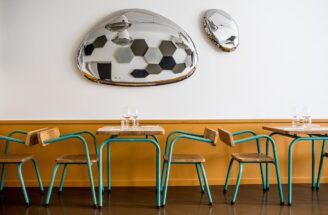
We came up with a lot of things ourselves, as a group of partners. Both the café and the branding – everything is inspired by Latin and South America, with warm colors. We knew we wanted that specific wood color and a marble bar, and then Julka Jankowska, an architect, helped us bring it all together. We did 90% of the renovation ourselves. We thought we wouldn’t have to touch the electrical work or plumbing – that those were already done—but that didn’t work out, and as is often the case with renovations, it took us twice as long as we’d planned.
In your opinion, what has changed over the past 16 years that you’ve been involved in the coffee industry? On the one hand, coffee culture seems fairly stable. How do you think the specialty coffee movement is evolving right now? What’s important, and where are the key areas of focus?
The customer has changed a lot – on the one hand, they’re more knowledgeable today and have vast access to information; on the other hand, specialty coffee has become so trendy that many people consume it superficially, following the trend rather than having a genuine interest in the product. Thanks to easy access to knowledge and tools, the market is growing rapidly, but at the same time, it’s replicating many patterns, which is why a natural reassessment is likely – similar to what happened earlier in the craft beer world. The ones that will survive are the best, the most consistent, the most educated, and the cafes in places where no one would have dared to open one before – in residential neighborhoods, in apartment buildings, at farmers’ markets, and in smaller towns. People are now looking for a sense of place; they want to hang out in their own neighborhood, as close to home as possible, because we have less and less time and less energy. For me, going downtown is a chore, even by bike. There’s nothing interesting there, so I think this is a trend – the “local café” movement. And as for AI-generated labels, I’m not a fan, but that’s the world we live in today.
Was there anything that surprised you when you opened Mała?
Honestly? Just how positive the response and feedback from people have been about what I do. I’m not the most confident person – I’m a perfectionist, I have high expectations, and I’m always raising the bar for myself—but the reception we’ve had here in Praga has been really nice, and it shows that sometimes it’s worth working hard after all.
Interview by Monika Brzywczy, photos by Kasia Łubińska
Share this entry on Facebook or copy link